
Of course we have written about this topic previously because it's a question we always get asked by potential sellers, but all advice needs to be brought up to date. Our original article dates from 2017. Can you remember 2017? It's a long time ago now and a lot has happened. Equally though, a lot has stayed the same, especially in the World of Spanish property. One thing though is plainly evident: Prices have risen a lot and therefore it's likely that anyone selling now has to deal with issues such as capital gains and local taxes. We introduced our sales tax calculator in last Wednesday's post but today we go deeper, a lot deeper. In today's post not only are we going to give you the calculator but also go into all of the potential costs of selling a property in Spain so you know what your total liability could be. Aren't we kind! Grab a coffee, sit down and learn.

What Does It Cost To Sell A Spanish Property?
The basic question remains the same, what costs are involved in selling a property in Spain? The answer of course like everything in Spain is "It depends". It depends on which autonomous community you live in, it depends on your personal situation of residency and age and a whole host of other factors. We'll go through them one by one here.
The Main Costs At A Glance
Below we'll go through the costs one by one and explain how somke are fixed, some depend on your position and some are variable according to how long you have had the property, what you originally paid for it and even what you really paid for it (how much is stated on the original deed) Some costs are unavoidable but some can depend on how the sale is handled.
Estate Agency Fees
This is one of the larger costs and it will depend in which part of Spain you are selling. Here is Valencia costs are split between buyer and seller so the selling fee is a standard 3% of the value of the property. Here at Valencia Property we charge 0% or 2% on sale. You can read about that here.
In the rest of Spain selling costs apply to the seller only meaning you will be charged 5-6% as standard, ouch! Now of course you can avoid this cost by selling privately but expect timewasters, scams, endless calls from agents, more calls from agents pretending to be buyers, from agents telling you they are not agents but they have a cousin who wants to see the property, agents who have an interested friend and more. And the odd call from tyre kickers, neighbours wanting to know how much their own house might be valued, people with suitcases full of "cash" and people making you offers of 50% of your asking price but you need to go to notary tomorrow.
Most people use an agency in Spain to maximise the price of the property. That's the job of an agency. The following shows a seller with two things; a massively overpriced property and a very weak negotiating position. When you say the price is 400k, say you will consider offers but you will not entertain offers below 300k, can you guess what offers you might get?
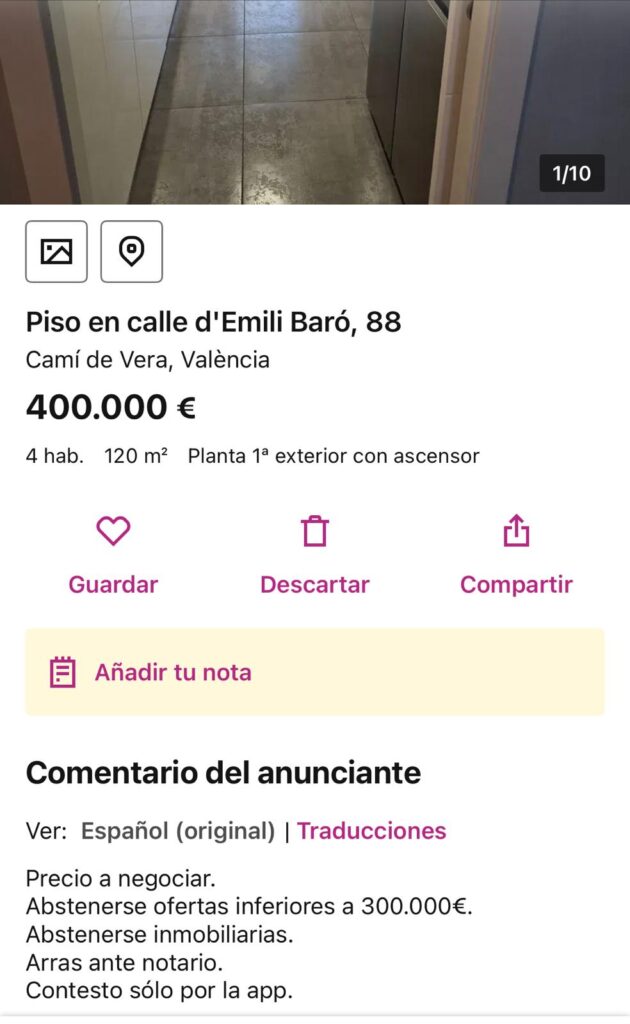
(It's interesting to note that the ad has now changed two days after the screenshot was taken. All it says now is "No agents" and "Deposit at notary office". There are ten awful photos and no contact details provided. It's probably a scam)
What Sellers Should Check
As a seller you should confirm the commission rate with the agent. You should also confirm when commission is due. It should be on completion but many agents charge it on deposit and it's non refundable even if the sale falls through. If an agent tells you this then it's probably best to run away and fast.
You should also check whether the agency has an exclusive right to sell on their contract (Because if they do and you find a private buyer you are still on the hook for their commission) You should also understand what services the agency is providing, it shouldn't just be putting up pictures and waiting to get paid (Because apparently that's all agencies do I was told recently. See the article here about that.)
Capital Gains Tax
Now in the past the agency fee was often the biggest cost for a seller on sale but now with the increase in prices in the last decade Capital Gains Tax (CGT) can often be the biggest cost. Not everyone has to pay CGT though. If the property is a primary residence and you are buying another place and "reinvesting" the gain then there is no CGT due. If you are over retirement age and selling then in most cases CGT is not due unless you are a non-resident. Equally as a resident if you sell another property that isn't a primary residence you have an allowance of up to 240k to buy a pension annuity meaning you don't pay CGT. You can work out your likely CGT in the table below but remember to continue reading below for other costs you may have as a seller.

Property Sale Tax Estimator
Use this tool to estimate the capital gains tax on a Spanish property sale. It distinguishes clearly between Spanish residents, EU or EEA non-residents, and non-EU non-residents, and it also shows the 3% withholding for non-resident sellers.
| Gain band | Rate |
|---|---|
| €0 to €6,000 | 19% |
| €6,000 to €50,000 | 21% |
| €50,000 to €200,000 | 23% |
| €200,000 to €300,000 | 27% |
| Over €300,000 | 28% |
Calculation breakdown
| Item | Amount | Notes |
|---|---|---|
| Net sale proceeds before tax | €0 | Selling price minus selling costs. |
| Total acquisition base | €0 | Purchase price plus buying costs and improvements. |
| Estimated taxable gain | €0 | If negative, no capital gains tax is shown. |
| Estimated capital gains tax | €0 | Depends on the selected taxpayer type. |
| Estimated cash after CGT | €0 | Illustrative only. |
Important note
This estimator is designed as a practical guide, not formal legal or tax advice. It does not calculate plusvalía municipal, main home exemptions, reinvestment relief, over-65 exemptions, inherited property adjustments, partial ownership issues, or cross-border credit treatment.
This version embeds the logo directly in the file so it should render reliably when moved or embedded.
What Can Reduce Your CGT Bill?
One of the most important things you can do to reduce your CGT bill is to keep meticulous records, especially if you are modernising the property. You have allowances against your capital gains bill including energy efficiency improvements, reforms of the property, and the costs associated with purchase and sale. Make sure to keep bills and make payments by bank transfer so you can prove they were costs and included VAT. Cash payments to a builder in hand are not deductions that are allowed or you can prove!
Plusvalia Municipal
The Plusvalia Municipal is the based on the notional increase in value of the land on which the property stands between purchase and sale and is levied as the name suggests at a local, municipal level.
How the Tax is Calculated
The rules changed permanently after a landmark court ruling in late 2021. Since then, sellers have had the right to choose between two calculation methods and pay whichever produces the lower bill. That right still stands in 2026.
Method A: The Coefficient Method
This uses the cadastral value of the land and the number of years you have owned the property. The government sets maximum annual coefficients, which individual municipalities can reduce but not exceed.
The formula is as follows:
Land Cadastral Value × Municipal Coefficient (based on years owned) × Local Tax Rate.
It's worth knowing that coefficients for long-term ownership of 20 years or more remain substantial. Coefficients for short-term sales under one year tend to be higher, which is deliberate policy to discourage quick flipping.
Method B: The Real Gain Method
This is "usually" more advantageous for you as a seller. Make sure to investigate this rather than relying on what the town hall may tell you
This method bases the tax on the actual profit from the sale. If the gap between what you paid and what you sold for is relatively small, this method usually works out cheaper.
The formula is as follows:
(Sale Price minus Purchase Price) × Percentage of Land Value × Local Tax Rate.
To use this method you will need to produce both sets of deeds, the purchase escritura and the sale escritura, so the Town Hall can verify the figures. Without them, Method B is not available to you.
If You Made No Profit, You Owe No PV Tax
The most important protection for sellers from predatory town halls is still in place in 2026. If you sold for less than you paid, or for exactly the same price, you are legally exempt from Plusvalía. No gain, no tax.
However, there is something that catches people out and that is assuming this process is automatic. It is most certainly not (That would be too simple right!). You still need to file a declaration with the Town Hall and provide your deeds to prove that no profit was made. Skip that step and you will likely receive a fine, even if no tax is actually owed.
Make sure to file the paperwork even if you make no profit. Doing so protects you.
Notary, Registry and Gestor (Admin) Costs
We often call this the NRG costs in our calculations we make for sellers (And buyers)
When you sell a property in Spain, there are several administrative and legal costs associated with getting the transaction over the line. Unlike some countries where everything may well fall neatly on one side, Spanish property sales involve a mix of shared costs and seller-specific obligations.
Who pays what?
The buyer typically covers:
- Notary fees for the deed of sale (escritura de compraventa)
- Land Registry fees to register the new ownership
- Gestoría fees for managing the paperwork and submissions
This is the standard arrangement, and it's written into most sale contracts in Valencia at least as the default position (Not necessarily the case in other autonomous communities. Make sure to check). The notary drafts and formalises the sale deed, the Land Registry updates the ownership records, and the gestor handles the administrative side where they file declarations, obtain certificates, and ensure all the paperwork is in order.
The seller is responsible for:
- Obtaining the nota simple (a current ownership certificate from the Land Registry) to prove clear title
- Energy Performance Certificate (EPC), known in Spain as the certificado de eficiencia energética
- Cédula de habitabilidad or certificado de habitabilidad (occupancy licence), if required in your region or if the existing one has expired
- Community fees certificate (certificado de deudas de la comunidad) showing that all community charges are paid up to date
- IBI certificate (certificado de deudas del IBI) proving that local property tax is settled
- Any outstanding utility bills and cancellation or transfer arrangements
These seller costs are relatively modest, usually a few hundred euros in total, but they're essential for a smooth transaction. Buyers and their lawyers will not proceed if any of these documents are missing or show outstanding debts.
What if there are complications?
If the property has charges, debts, or liens registered against it, the seller must clear these before completion. This might involve paying off an old mortgage, settling unpaid community fees, or resolving historic IBI arrears. The notary will check the Land Registry records before signing, and any unresolved issues will delay or block the sale. (Usually mortgages are cancelled on the day of signing, along with any associated cancellation costs, using the funds from the purchase)
In some cases, both parties may agree to share certain costs, especially if the transaction is unusual or involves a power of attorney, extra certifications, or complex paperwork. Always clarify this in the contrato de arras (reservation contract) to avoid last-minute disputes. Even if you do there may be last minute disputes (as was the case in the notary this week when the seller and their agent obviously hadn't read what they had signed and weren't in agreement with the 3% withholding tax!)
Practical costs to budget for
For most straightforward sales:
- Nota simple: €10–€20
- EPC: €100–€300 (depending on property size and location)
- Occupancy certificate (if needed): €100–€250
- Community and IBI certificates: Usually free or a small admin fee (€20–€50 each)
- Gestor support (if you use one to obtain documents on your behalf): €150–€400
The buyer's side, notary, registry, and gestor for the purchase, will run into the thousands especially when the payment for purchase tax is added, but that's their responsibility under the standard Spanish property sale structure.
The Main Takeaway Point
As a seller, your main obligation is to deliver clean title and provide the documentation that proves it. The buyer handles the cost of formalising the deed and registering the new ownership. Budget a few hundred euros for certificates and paperwork, and make sure everything is in order well before the scheduled completion date.
Legal and Professional Fees
We often repeat ourselves here... for a seller a lawyer may well not be needed. In Spain it's buyer beware so we would never say a buyer shouldn't have a lawyer. Don't skimp there. However as a seller this is one area where you can quite easily avoid a pointless cost. Except...
Yes there are exceptions. If the sale is a complicated one, maybe because of an inheritance, or one requiring a power of attorney, maybe because of a divorce where neither of the selling parties wants to talk to each other or even for non-resident sellers who don't want to deal with paperwork and bureaucracy from abroad then a lawyer for the seller can be useful. They can also check out any deposit contract you are presented with that may have "Extra" clauses and stipulations away from the norm that only benefit the buying party. It's up to you. Here at Valencia Property we generally say you don't need a lawyer for sale, however if there are any doubts we will advise you to get a lawyer to make sure everything runs smoothly.
Other Professional Costs
These may well be optional in all cases but you may incur costs for translation services, tax advice and preparation, architect's fees for signing off any extensions or changes made to the property if not done already and costs for setting up a power of attorney for a lawyer, agent or even a friend as a named representative.
Such costs may be worthwhile depending on your circumstances. They may avoid you having to take an expensive plane journey across the world and unpaid days off work or even just give you the peace of mind to know that everything is going to run smoothly. However, they are optional in most cases so of course they are not included in the calculator above.
Non-Resident Seller Issues
There may be extra steps when you are selling as a non-resident as opposed to a resident. The most important one of these is the withholding tax issue. We explain it clearly in the calculator and the fact that it is a payment in advance of potential tax, meaning you will either get an extra tax payment demand or have the right to claim some or all of it back. The actual tax liability doesn't matter, the 3% is withheld in every case as a starting point. Your tax residency status has an effect on the money you receive.
Equally, it is important to plan ahead and collect all of the paperwork needed before sale as missing documentation, uncertainty about processes and unresolved ownership questions (Such as an inheritance that hasn't been inscirbed in the property registry for example) can throw major spanners into the works and cost both time and money to resolve.
Example of Selling Costs
To get an example of selling costs you can play with the calculator above. However, we have also put together a full example below so you can see how selling costs work. This is based on a resale property in Valencia city, showing the main costs a seller might face and what's left at the end.
The scenario
- Original purchase price: €280,000 (paid in 2016)
- Purchase costs at the time:
- ITP (transfer tax) at 7%: €19,600
- Agency, legal, notary and other costs: €8,400
- Total acquisition cost: €308,000
- Sale price today: €495,000
- Ownership period: 10 years
- Seller status: Spanish tax resident
- Location: Valencia city (for plusvalía municipal calculation)
The calculation
1. Sale price
€495,000
2. Agency commission (3%)
€17,969
The agency fee is the biggest single selling cost for most people. At 3% plus 21% VAT, this comes to just under €18,000 on a property at this price level.
Breakdown:
Total agency cost: €17,969
Base commission (3% of €495,000): €14,850
VAT at 21%: €3,119
3. Capital gains tax
Taxable gain:
- Sale price: €495,000
- Less: original purchase price: €280,000
- Less: original purchase costs (ITP, agency, legal, notary): €28,000
- Less: selling costs (agency €17,969 + legal/admin €2,100): €20,069
- Net capital gain: €166,931
Tax due (Spanish resident, progressive rates):
- First €6,000 at 19%: €1,140
- Next €44,000 (€6k–€50k) at 21%: €9,240
- Remaining €116,931 (€50k–€166,931) at 23%: €26,894
- Total capital gains tax: €37,274
This is the tax on the profit you've made over ten years. Spanish tax residents pay progressive tax rates (19%–28%) on the gain. Non-residents pay a flat rate, 19% for both EU/EEA citizens and non-EU citizens. They too can also deduct the original purchase costs, legal fees, and documented improvements, just like residents. The main difference is the rate structure. A Spanish resident would in this example pay an effective CGT rate of 22.33% on €37,274 profit as there are three separate tax bands for the increased value. A non-resident would pay 19% meaning a non-resident would pay €31,717 in capital gains tax on the same gain, which is €5,557 less than the Spanish resident pays (€37,274).
For gains above €50k, EU non-residents actually pay less tax than Spanish residents because they avoid the higher progressive bands (21%, 23%, 27%, 28%) and stay at the flat 19% rate.
4. Plusvalía municipal (local land value tax)
This depends on the cadastral land value and the number of years you've owned the property. For a typical property in Valencia city held for 10 years:
- Estimated cadastral land value: €50,000
- Annual increase factor (maximum allowed): 3.7%
- Tax rate in Valencia: 29%
Rough calculation:
- Taxable base: €50,000 × 3.7% × 10 years = €18,500
- Plusvalía tax: €18,500 × 29% = €5,365
The actual figure will depend on the property's specific cadastral value and the municipality's chosen rate, but this gives you the scale. Plusvalía can be significant, especially for long-held properties in well-located areas but is often really low. The same calculation for a property held for just 2 years would give a tax payment of 1073 Euros.
5. Legal and Admin Costs
If you use a lawyer to handle the sale, check documentation, and ensure everything is settled correctly, budget around €1,500–1%. You'll also need:
- Energy Performance Certificate: €200
- Nota simple and other certificates: €100
- Gestor support (if needed): €300
Total legal and admin: €2,100
6. Summary: what's left?
| Item | Amount |
|---|---|
| Sale price | €495,000 |
| Less: Agency commission (inc. VAT) | (€17,969) |
| Less: Capital gains tax | (€37,274) |
| Less: Plusvalía municipal | (€5,365) |
| Less: Legal and admin costs | (€2,100) |
| Net proceeds to seller | €432,292 |
How This Looks In The End
Out of this theoretical €495,000 sale, this seller walks away with around €432,292 after all costs and taxes. That's about 87% of the sale price.
The biggest single deduction is capital gains tax at nearly €38,000, followed by the agency fee at just under €18,000. Bear in mind that the job of the selling agency is to maximise your sale price and they may well more than earn you this amount by their marketing of the property. Together, these two costs account for most of the difference between the headline sale price and what actually lands in your bank account.
How to reduce the bill
- Keep all your purchase receipts: The original purchase costs (tax, legal, notary, agency) can be deducted from your capital gain, which saves thousands in tax. In this example, the €28,000 in documented purchase costs saved around €6,500 in capital gains tax.
- Document any improvements: Major refurbishments, extensions, or upgrades can also be deducted if you have invoices. If you spent €20,000 on a new kitchen and bathroom with proper invoices, that's likely another €4,600 saved on tax.
- Get the plusvalía calculation checked: Some sellers overpay because the town hall uses an inflated cadastral value or applies the maximum rate. Your lawyer or gestor can review the calculation and challenge it if it's wrong.
- Check the agency fee: This commission would be lower if you were to use Valencia Property for example as we charge 0% or 2% as mentioned above. If your property is highly marketable or you're selling at a premium price, you may be able to get a lower percentage with your chosen agent but in many parts of Spain you will be paying 5-6% as opposed to 3% or less, the case in Valencia. Certain big name agencies charge considerably more so be careful of huge marketing budgets which YOU end up paying for. Don't go for the lowest fee, go for the best deal and the agency that gives you confidence that they will be able to sell your property. Ask questions and be prepared to walk away. If they are asking for an exclusive ask why and what value they add for that exclusive. We never ask for an exclusive and yet most people use no other agency when they use Valencia Property.
The Main Takeaway Here
Selling a property in Spain involves real costs of course and you should be aware of them but they largely depend on any capital gains bill. If you plan ahead, keep good records, and get professional advice, you get to keep the bill as low as possible and avoid any nasty surprises at completion.
Conclusion
Selling a property in Spain is simple enough if you understand the process, understand the costs involved and gather your paperwork together in advance. Most issues can be sorted easily enough with good preparation and advice. Our original article from nine years ago stands up really well still but it was time for an update and to be more thorough about everything, if only to make this advice more visible. If you have any questions feel free to contact us and if you want us to come along and take a look at your property for sale then let us know and we can make an appontment to come and see it. Just fill in the form below.

Thinking About Selling?
If you want to look into selling your property in Valencia let us know. Just fill in the form below and we'll contact you to come and take a look and advise you as to the best way to proceed.
Thanks — we'll be in touch
We've received your details and will contact you shortly to arrange a visit and talk through the best way to proceed.
Other Useful Posts
We have been publishing a lot in the last few weeks to give you much more information, forms, guides and more. If you want to see more then just click the images below starting with our Buying Costs Calculator.




 WhatsApp us


